Bayonne
The Glass RoomBayonne is the border crossing where the Landauers’ flight from Europe becomes a scene of forced separation. At the station, German soldiers order passengers off the train and inspect their documents; despite Katalin’s refugee passport and the family’s other papers, officials take her and her daughter Marika away. The station exposes the distance between possessing documents and being allowed to pass: a border can be newly drawn, bureaucratically administered, and still decide who remains with a family and who is pulled from it.
The border as a changing line
Earlier, Rainer von Abt complains that passport control has become ridiculous: the world moves forward, he observes, yet a new border control appears where none existed before. Liesel replies that this is a small loss of freedom compared with the freedoms gained. His question about whether she herself is free makes the exchange more than a comment on travel. The border’s novelty sits beside a less easily measured constraint, while the later journey makes clear that a change in political geography can impose immediate, material limits on movement.
As the family prepares to leave, Liesel watches the Bohemian coast recede and imagines Hana standing on the shore, waving as she had at the aerodrome. The view makes departure visible as a severing from home and from the people left behind. Viktor presses the practical preparations forward: they are to pack and be ready when the train tickets are confirmed, with a hotel near Geneva as an interim plan. His confidence in America as a place beyond Europe’s conflicts clashes with Liesel’s insistence that memories are not useless; they are all that remain. Bayonne belongs to this widening break between the urgency of escape and the irretrievable past it cannot leave behind.
The journey to Bayonne
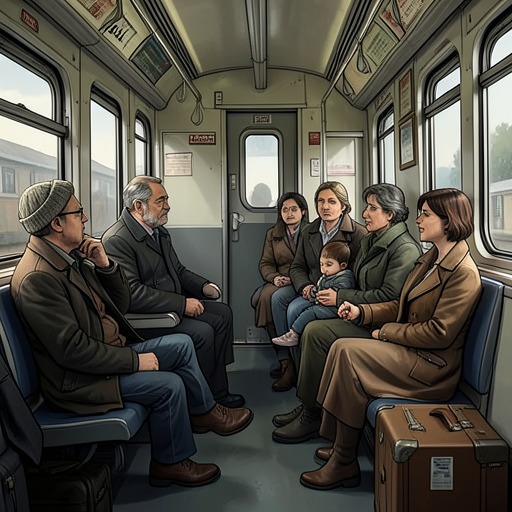
The train journey is filled with competing accounts of what lies ahead. Passengers speculate about changing trains at Biarritz, proceeding into Spain, walking across a border, and having their papers checked—or not checked because the train might already count as being in Spain. Nobody knows which account is true. Earlier, when Liesel asks whether the train will stop at the border, Viktor points to the police moving along the corridor and says that this is the border; the letter she hopes to send will have to be posted in Bayonne or elsewhere. Her concern about Swiss stamps, and Viktor’s assurance that stamps can be obtained in Bayonne or Spain, reduces international passage to a practical problem that the coming inspection will render far less manageable.
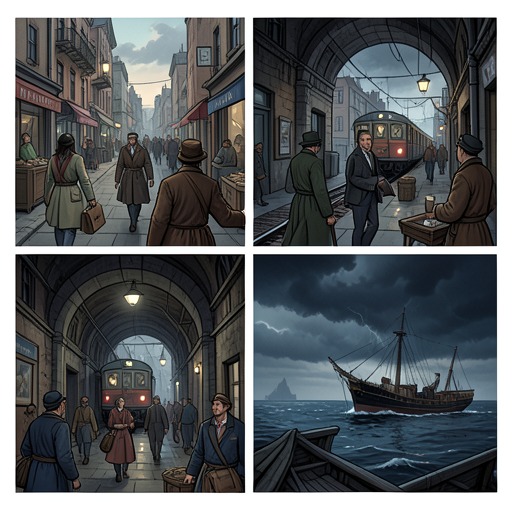
On the afternoon the train enters Bayonne, Liesel cries out at the sight of soldiers. Katalin whispers that they are Germans, surprised because she thought German forces were in the north and the French in the south. The station sign confirms the place as the train stops amid shouts and doors thrown open. Soldiers hammer on a window and order everyone out. Liesel and Katalin gather their belongings, uncertain whether to take everything; passengers press down the corridor and onto the platform, while an old woman is helped down the steps and hurried by those behind her. The hurried, confused movement makes the station a place where ordinary travel gives way to command.
Inspection and separation
The passengers are made to queue while soldiers search the train. A disturbance breaks out in one carriage, and a person is dragged away. Rumours spread that the Germans have found people travelling without papers; some passengers are taken into station buildings for questions about their documents and identity, while most are allowed back aboard. Relief passes through the crowd, but it is inseparable from the fear that any traveller might fail the test. The inspection is not an orderly confirmation of a known right to pass: its outcome remains uncertain until each person reaches the desk.
When an official demands documents from Viktor, he lays the family’s papers out in neat piles and identifies those travelling with him: himself, Liesel, their two children, the children’s nanny, and her daughter. The official examines the passports and French transit and Spanish visas, then demands the tickets. The description of the tickets as a winning hand underscores the gamble built into the encounter: the papers appear complete, yet the family cannot know whether that will suffice. The official’s uniform and title, Feldgendarmerie, place this arbitrary-seeming moment of scrutiny within the authority of German military policing.
The official questions Katalin’s papers. Viktor tries to answer for her, but is told, with elaborate politeness, that he was not asked to speak. After a brief consultation, a uniformed figure takes Katalin by the elbow and leads her toward a hut. Marika cries out for her mother; Liesel pulls her close and says that she will be all right. Asked whether the child belongs to the woman, Liesel insists that Marika is with the family and that they will look after her. The exchange makes Liesel’s attempt to protect the child immediate and concrete, even as the officials proceed to separate the two.
A family divided
A soldier then leads Marika toward Katalin, pushing her in the same direction. Katalin looks back desperately and calls to Viktor. He shouts that her papers are in order and identifies her document as a Nansen refugee passport. His protest specifies the gap between legal documentation and practical safety: Katalin had used the documents to leave Czechoslovakia, and Viktor argues they were valid for entry into France and Spain, but their apparent validity does not prevent her detention.
The official warns Viktor to return to the train unless he wants to be detained as well. Viktor repeats that Katalin has everything required, but the crowd presses forward, absorbed by its own desire to avoid becoming the next unlucky case. The official tells him to move on for his own sake and suggests that the delay may be temporary. A young soldier pushes the family toward the carriage as one might push cattle, then takes Katalin’s and Marika’s suitcases away. The assurance that matters may work out is left suspended against the immediate evidence: mother and daughter have been taken to a hut, their luggage removed, and the rest of the family sent onward.
Bayonne therefore marks more than a stop on the route toward Spain. It is where the family’s carefully assembled travel arrangements fail to secure everyone’s passage together, and where the official machinery of the border turns a refugee’s papers into grounds for scrutiny rather than protection. The station’s repeated concern with stamps, visas, passports, and identity culminates in a division that no ticket can resolve. For Liesel, the receding coast and Hana’s remembered wave have already made departure a loss; at Bayonne, that loss becomes a separation within the travelling family itself.